
Brown County Previous Resident Sources
Choose the first source by date. Recent ownership starts in the parcel record and deed index. Older occupancy is more likely to appear in a city directory or census. A map or assessment card can bridge an address change, but it cannot name every person who lived in the building.
| Source | Years It Covers | Where Held | What It Shows |
|---|---|---|---|
| Online deed index and images | February 1, 1962 to present | Brown County Register of Deeds | Recorded parties, instruments, dates, legal descriptions |
| Land and tax records | 1820–2005 by request | UW-Green Bay Archives | Owners, tax entries, parcels, municipalities |
| Green Bay and county directories | Some editions from the 1870s | Brown County Library and archives | Dated names, addresses, occupations, business labels |
| Federal and state census holdings | Wisconsin federal 1820–1930; Brown 1940; selected state years | Brown County Library | Households and neighbors at a census date |
| Assessment cards, maps, photographs | Varies by collection | UWGB and Wisconsin Historical Society | Building identity, form, date clues, source trail |
For a modern trail, establish the parcel and deed chain first. For an older Brown County address, start with the closest dated directory and pair it with a census, map, tax entry, or assessment card. The absence of one year should be marked as a gap, not filled by assumption.
UWGB Builds Brown County House Trails
The UW-Green Bay house-history guide lays out an unusually broad evidence stack: assessment cards, deeds, directories, census, cemetery and church records, board minutes, maps and plats, newspapers, photographs, oral histories, and tax records. Its strength is not a master list of previous residents. It shows how different records can identify the same building and the people tied to it at different times.
The guide's source map is preserved in this capture:
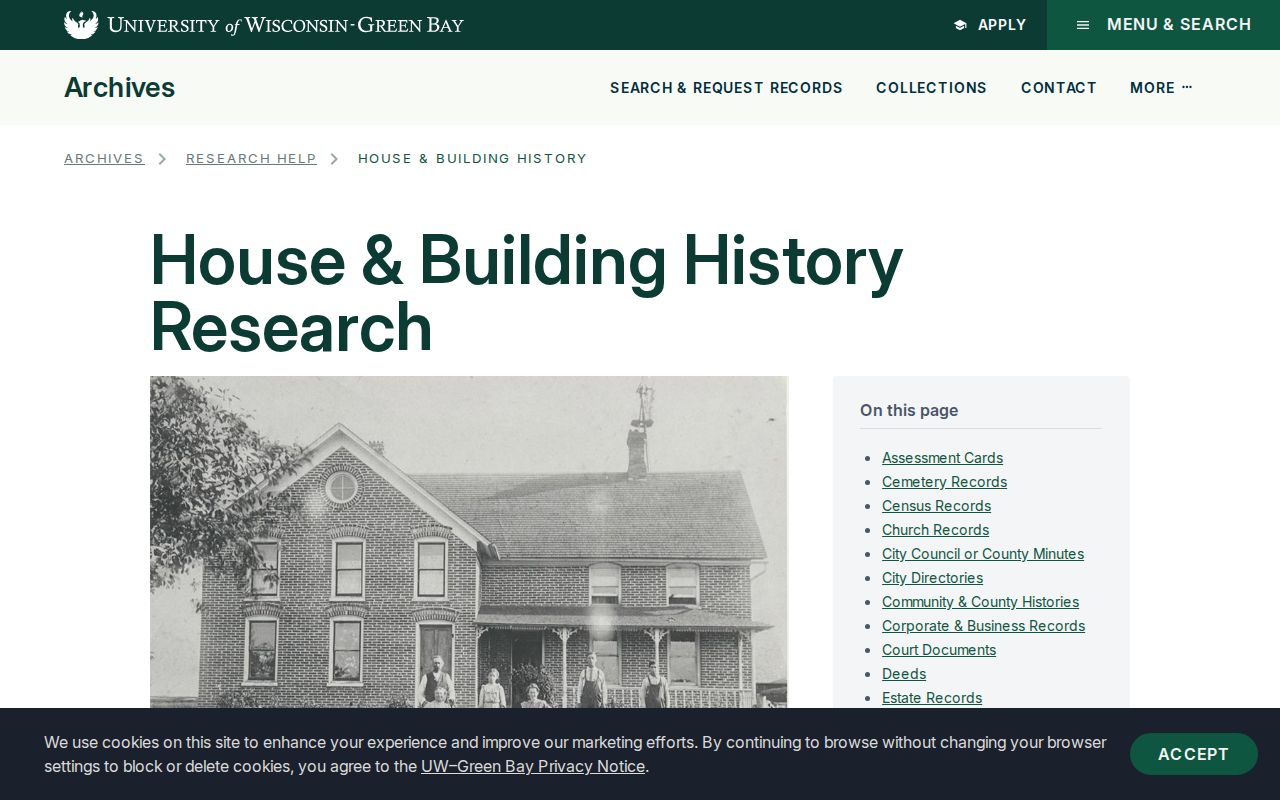
Pair at least one place source, such as a map or assessment card, with one dated people source, such as a directory or census. That pairing is much stronger than a lone surname.
Trace Brown County Owners Backward
The current tax listing supplies a starting name, parcel ID, and legal description. The Brown County Register of Deeds search then provides a Grantor/Grantee index and document images from February 1, 1962 forward. The street address may change, so copy the legal description and prior document reference exactly.
- Find the current or historical parcel in Brown County Land Records. Save all owner names, parcel identifiers, and the legal description.
- Locate the present owner's acquisition instrument. Record its number, date, type, grantor, grantee, and prior reference.
- Search the seller as a prior grantee to find that party's acquisition. Match the description, not just the surname.
- Repeat until the chain reaches the online cutoff or a break caused by an estate, split, merger, or changed description.
- For earlier work, use the appointment-only Register terminal, archival land and tax records, deed books, and historical property sources.
- Grantor / grantee
- The grantor gives a recorded interest; the grantee receives it.
- Chain of title
- The linked sequence of recorded transfers for the same land.
- Legal description
- The formal land description used in records. It can remain useful when a street number changes.
A deed does not prove occupancy. Keep the role as owner or recorded party until a directory, census, obituary, or other source supports residence.
Request Brown County Archive Records
The UWGB Archives search is a partial index with no digital images. It covers indexed genealogy material and accepts searches by first name, last name, county, collection, Soundex, keywords, case type, corporate name, and role. A no-result screen is not proof that the archive lacks a record. Try a surname alone, spelling variants, and Soundex before submitting a request.
Property requests can specify the owner, county, municipality, year or span, section, parcel, and lot or block. The posted service fee is $10 for up to 20 pages, then $0.50 per added page, with $5 more for notarization. Heavy-traffic response time is estimated at six to eight weeks. Material can also be viewed free in the archives. Call 920-465-2539 or email archives@uwgb.edu for the current process.
The official UWGB request screen captured here shows the partial-index route:
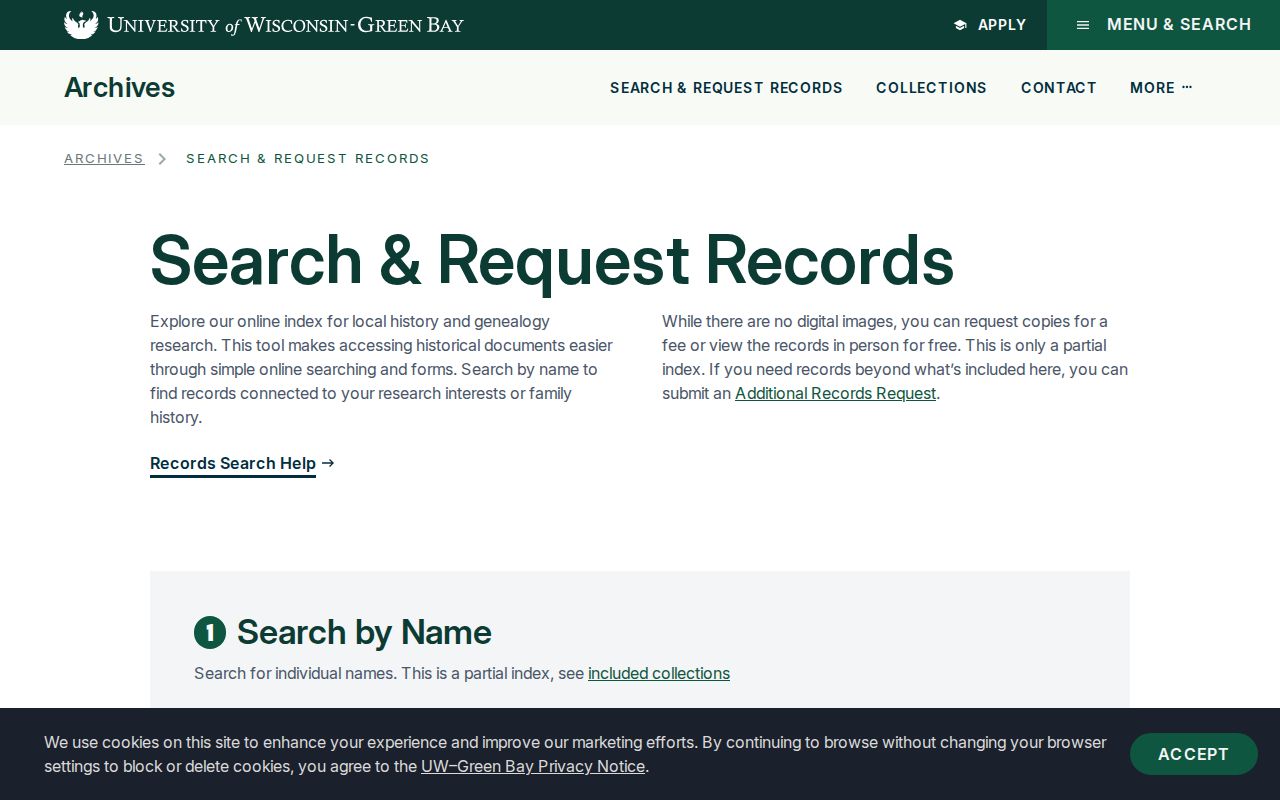
Save the collection name and spelling tried. Those details make a staff request focused and reproducible.
Brown County Address Continuity
One Wisconsin Historical Society record shows why a current number may fail. A Green Bay property now recorded at 110 S Adams Street was formerly 112 S Adams after rehabilitation, and the bibliography cites a 1939 directory. Treat this as a method, not as proof that every street was renumbered.
Make a same-place worksheet with the modern parcel situs, postal result, current municipality, deed description, old directory label, and map block. Green Bay Sanborn fire-insurance sets include 31 sheets from 1900 and 85 sheets from 1907. A Sanborn map dates a building footprint and use; it does not by itself identify all occupants. Pair it with a directory and a newspaper notice from the same period.
The Wisconsin Historical Society property record is an example of a bibliography that points outward to tax rolls, a plat, and a city directory:
That source trail can reconnect an old label to a known parcel even when no single database contains the whole history.
Brown County Directory and Census Pairing
The Brown County Library Local History and Genealogy collection holds Green Bay city and Brown County directories, some dating to the 1870s, plus census and newspaper material. A directory entry can supply a year-specific address, occupation, business label, or household context. Coverage varies by edition, so record the title, year, page, arrangement, and format.
Pair sources in a short cycle:
- Find the address or surname in the directory closest to the target year.
- Check the nearest available federal or Wisconsin state census for household members and neighbors.
- Compare the address to a map, plat, deed description, or assessment record.
- Use newspapers, cemetery records, or probate files to explain a move, death, inheritance, or name change.
The library lists Wisconsin federal census holdings from 1820 through 1930, Brown County and selected-area material for 1940, and state censuses for 1855, 1875, 1885, 1895, and 1905. The 1890 federal population schedules were destroyed by fire, though a veterans and widows special schedule survives. Staff cannot perform census searches and have limited capacity for other research, so plan a self-directed visit or a focused question.
The library collection page shown here is the current access guide:
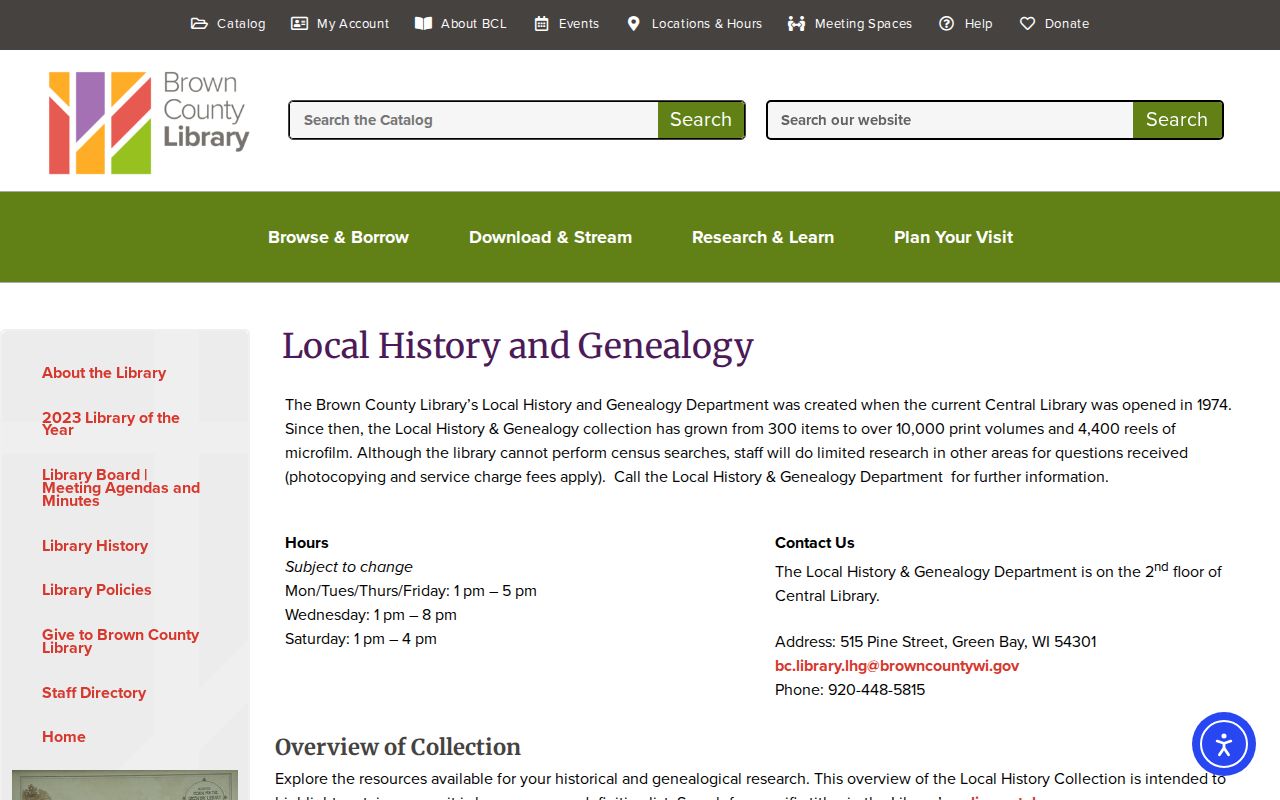
Its mix of directories, microfilm, census aids, and newspapers makes it the central in-person stop for a dated household trail.
Confirm Brown County Past Households
Owners are only one part of a house's story. Dated directories and census schedules may identify past residents who never held title. The historical editions themselves are described on the Brown County city directory page. Here, each entry serves as one dated link in a single address trail. Do not carry a person into a missing year without evidence.
Newspapers can close the trail. The library's Press-Gazette finding aids include a card index for 1962–1983, a print subject index for July 1985–December 1996, a catalog index for 1997–2003, and full text from 1999 forward. Earlier Gazette and Advocate runs can hold estate notices, moves, sales, and obituaries. Date overlaps do not mean every issue appears in every platform.
UWGB also holds Brown County citizenship records from 1829–1984, court case files from 1823–1939 by request, and land and tax records from 1820–2005 by request. Probate and estate material may explain why a deed chain jumps between relatives or an estate, but it still needs to be tied back to the property description.
Lawful use. Research Brown County previous residents for house history, genealogy, estate work, and personal curiosity. Never use the result to track, harass, or harm a living person.
Write the conclusion as a set of sourced roles: recorded owner, directory occupant, census household member, mailing addressee, relative, or unknown. That preserves both the human story and the limits of the evidence.