
Finding Brown County Residents
Choose the first record by what is known. An address belongs first in Brown County Property Listing, which can reveal a parcel, tax-listing record, legal description, and municipality. A name may fit Wisconsin MyVote, Wisconsin Circuit Court Access, or an old city directory. A document number belongs in the Register of Deeds index. Keep the date and the person's role beside every result. An owner, mailing addressee, voter, court party, and historic occupant are not interchangeable.
Official rolls are useful evidence, but none is a complete household list. A deed shows a recorded property interest, not who lives there. A mailing address may belong to an owner elsewhere. Protected records may not appear at all. Brown County residents directory research is strongest when two independent sources agree on a name, place, and time.
- Normalize the address with USPS, including any unit.
- Find the current or historical parcel and record its municipality.
- Use the name in the state index suited to the question.
- Compare dates and roles across deeds, directories, and court records.
- Ask the custodian for a specific record when the portal trail ends.
Brown County Directory Custodians
Three custodians handle much of the current trail. The Register of Deeds keeps recorded real-estate documents and vital records. Property Listing coordinates county tax-listing data, while each municipality remains important for appraisal details and some address questions. The County Clerk administers elections and directs voters to MyVote and local clerks. The full address method belongs in the Brown County street directory; these offices are the starting points when a portal is unclear or an official copy is needed.
Brown County Register of Deeds
305 E Walnut St, Room 260
Green Bay, WI 54301
920-448-7809
Brown County Property Listing
305 E Walnut St
Green Bay, WI 54301
Municipal contacts listed online
Brown County contains 24 municipalities. Local clerks and assessors can resolve records that depend on town, village, or city authority. County Planning assigns new addresses only in specified towns and the Village of Denmark, so an address problem may need the responsible municipality rather than a countywide correction.
Brown County Parcel Search Fields
The Brown County Land Records portal separates current and historical properties. That choice matters after a parcel split, merge, condominium change, or new identifier. The county tax-map search adds owner-name and survey controls that were not visible on the inspected Land Records form. Try both systems and retain the exact parcel ID.
| Field | Use | Limit |
|---|---|---|
| Parcel number | Open one tax-listing record | Prior IDs may differ |
| Address and municipality | Match a situs address | Postal city can differ |
| Plat, section, township, range | Find rural or surveyed land | Needs legal-description terms |
| Current or historical | Follow parcel changes | Search both states |
The county warns that its listing omits some appraisal details, including photographs, square footage, bed and bath counts, and age. Those belong with a municipal assessor when available. Save situs and mailing addresses in separate fields because the tax-bill destination does not prove occupancy.
Brown County Deed Directory Trail
The Register of Deeds real-estate service offers a grantor-grantee index and images from February 1, 1962 forward. A grantor transfers an interest; a grantee receives it. Online routes include Laredo and Tapestry. An appointment-based public terminal is another channel. Older material requires the terminal, archives, or a focused request, not a conclusion that no deed exists.
The office's 2026 budget says its tract index covers more than 101,300 parcels and that 28,035 real-estate documents were recorded in 2023. A common name can therefore return many unrelated entries. Use the parcel, municipality, document date, type, and legal description to keep the Brown County resident trail attached to the right land.
The manifest capture of the official search page shows its coverage and access choices.
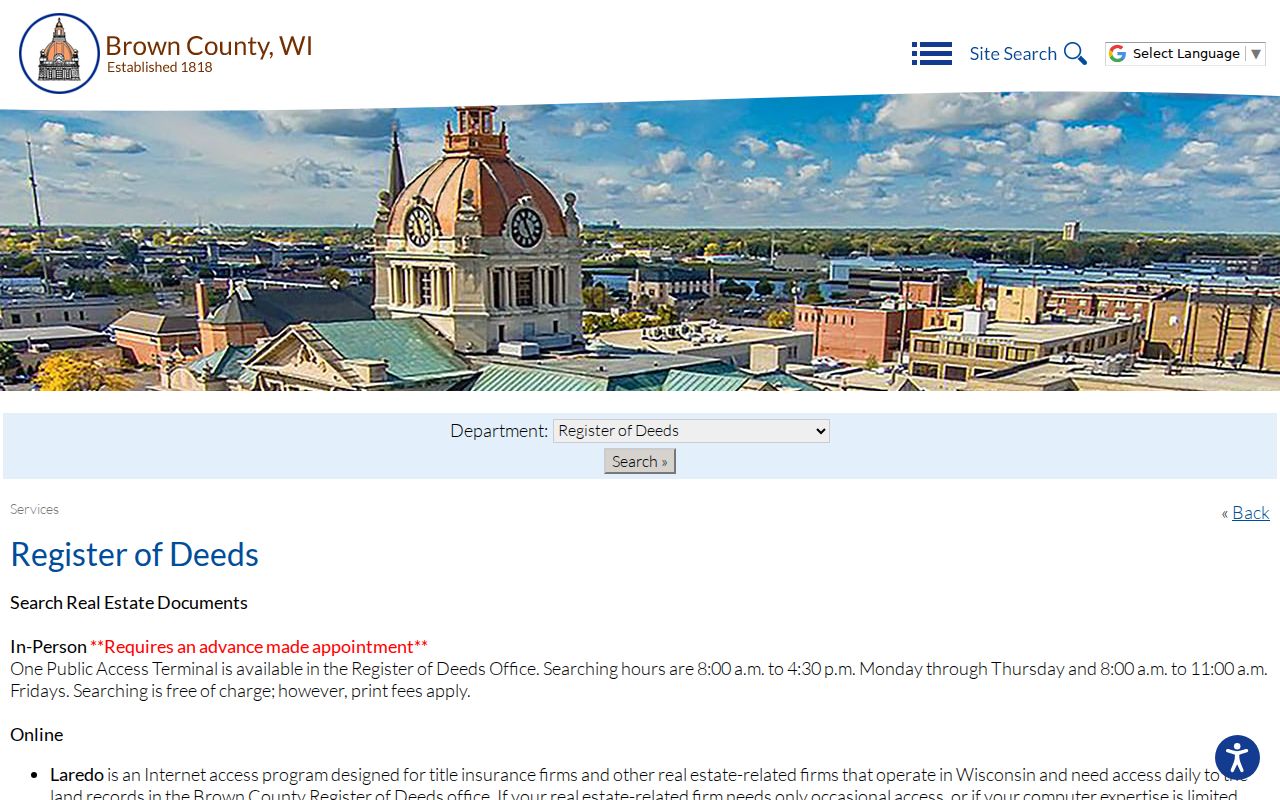
The screen confirms that online services and the courthouse terminal are separate routes to the same custodian.
Current Brown County Resident Rolls
Current directory-like records describe different relationships. Property data is address and ownership evidence. MyVote is registration evidence. Recorded deeds name transaction parties. Courts name parties to public cases. Corporate and license tools document business roles. A useful Brown County residents directory labels each result instead of merging names into a broad claim.
| Official source | Relationship shown | Custodian | Channel |
|---|---|---|---|
| Property Listing | Owner and mailing addressee | County and municipal assessors | Free portal |
| MyVote | Matched registered voter | Wisconsin elections system | Required search details |
| Deed index | Recorded document party | Register of Deeds | Online and terminal |
| WCCA | Public circuit-case party | Wisconsin courts | Free summaries |
| DFI Corporate Records | Business agent or officer | Wisconsin DFI | Free search |
Commercial people-finder results can be stale, merged, or missing source dates. Official rolls identify the custodian and the record's purpose, though they still require care. For one individual, the Brown County resident lookup gives a source-by-source verification method.
Brown County Voter Directory Limits
Wisconsin MyVote searches by name and birth date or by street, unit, city, and ZIP. It can show current registration, jurisdiction, voting history, and absentee or update options. Participation beyond the portal's ten-year display belongs in a Badger Voters request. Public data elements can include status, address, jurisdiction, county, and contact information if it is on file.
A voter result helps confirm that a matched person had a stated link to Brown County. It does not prove ownership or identify every occupant. Local clerks answer municipal election questions, and Wisconsin Safe at Home can protect an actual address. Record the query mode and access date because registration and participation data change.
The manifest image from MyVote preserves the two official search routes without using real resident data.
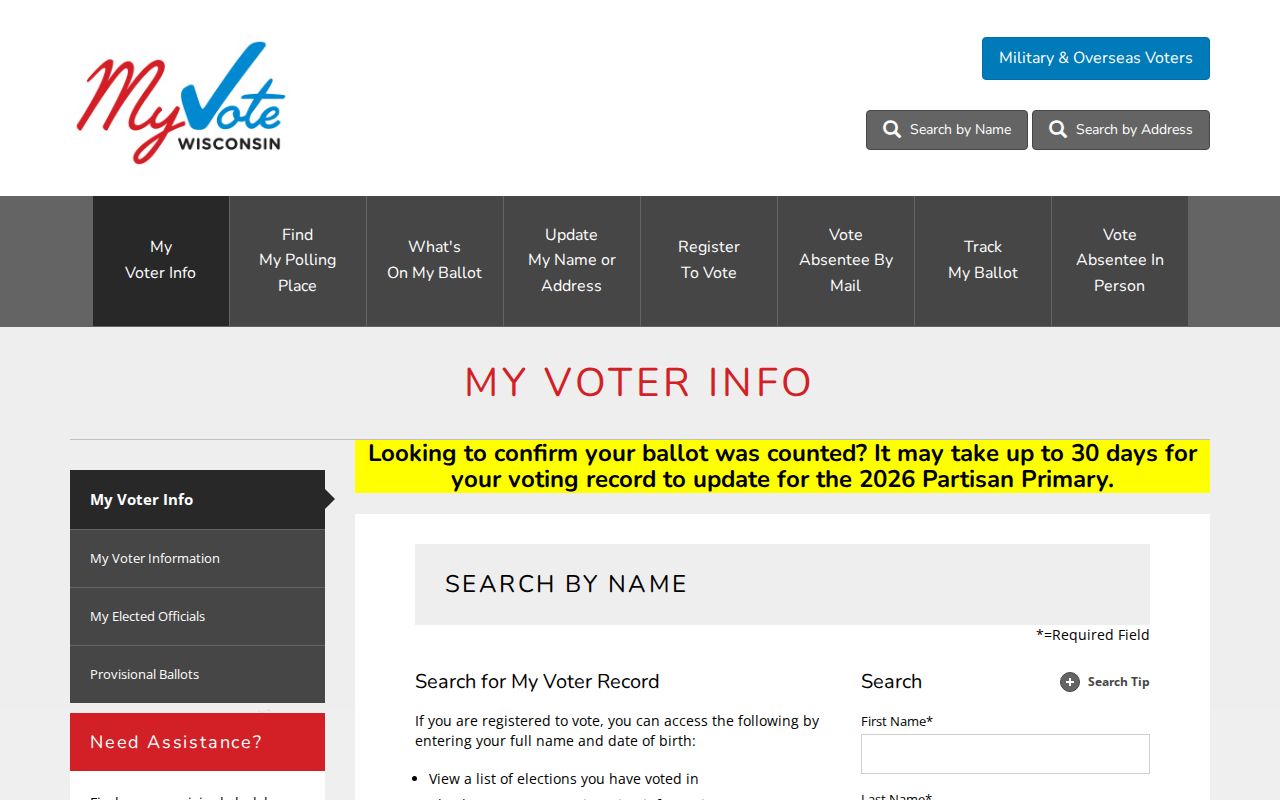
The visible fields show why a full address or birth date is needed to narrow a common name.
Brown County Court Record Search
Wisconsin Circuit Court Access publishes statewide circuit-court summaries with county, type, status, date, and party filters. Brown County describes public electronic access back to 1990, but not every paper is printable online. Sealed, juvenile, expunged, prejudgment paternity, and other protected matters are excluded or limited. No result means only that the query found no public electronic match.
For a known case, the Clerk of Circuit Court copy service accepts in-person, mail, phone, fax, and email requests. Give the case number and name the docket entry, judgment, or filing wanted. Green Bay Municipal Court separately covers civil ordinance matters from January 1, 2004 forward and reports weekly Thursday updates. A municipal citation is not a criminal conviction.
- Docket
- The dated list of filings and court events.
- Index
- A finding aid that may not contain the image.
- Certified copy
- An official copy authenticated by its custodian.
Brown County Vital Record Access
The Brown County Register of Deeds and Wisconsin Vital Records provide in-person, mail, and approved online routes for birth, death, marriage, and divorce records. Statewide records generally begin October 1, 1907. Applications require identification and a fee. Certified copies are limited by direct-and-tangible-interest rules, while uncertified and genealogy access have different limits.
For older family research, use the DHS genealogy indexes, Brown County's appointment-only genealogy room, library census tools, and UWGB Archives. An index can point to an event, but it is not the certificate. Preserve the exact name, date range, county, index title, and page or record number before ordering.
Brown County Records Law Requests
Wisconsin Public Records Law, Wis. Stat. §§ 19.31-19.39, favors access to government records while allowing lawful restrictions and redaction. The Wisconsin Department of Justice guide explains access, timing, and review of denials. A request can be oral or written, but precision helps. Name the office, record type, subject, date range, and delivery format.
Green Bay accepts requests online, by mail, email, phone, and drop-off. Its form states a 25-cent-per-page copy charge and warns that actual costs or prepayment may apply. County offices have their own custodians and schedules. Ask for an existing record, not an answer to a broad question. Keep any written denial and the rule cited.
Brown County ZIP Geography
A postal city is not always the legal municipality. Brown County includes 24 municipalities. An address can carry a familiar postal label while its parcel lies in a village or town with a different clerk, assessor, or address authority. Start with USPS ZIP Code Lookup, then compare its result with the county parcel and municipal-boundary layers.
Wisconsin's ZIP-class table separates standard, post-office-only, and unique ZIPs. A post-office box or acceptable city name cannot establish where a parcel sits. Census ZCTAs are statistical areas, not delivery ZIP boundaries. Save the USPS form, legal municipality, county, parcel situs, and mailing address as separate facts.
Brown County Archive Search
The Brown County Library local-history collection holds more than 10,000 print volumes and 4,400 microfilm reels. City directories begin in the 1870s, alongside newspapers, federal and state census sources, card indexes, and HeritageQuest. Staff provide limited research, so a focused surname, address, edition, and year saves time.
UW-Green Bay Archives adds citizenship, court, land, tax, probate, and regional genealogy collections. Its online index is partial and does not provide images. A request covers up to 20 pages for $10, with added pages at 50 cents and a stated six-to-eight-week estimate. Try Soundex and surname-only forms when exact spelling fails.
The manifest capture of the library collection page shows the range of Brown County residents directory sources.
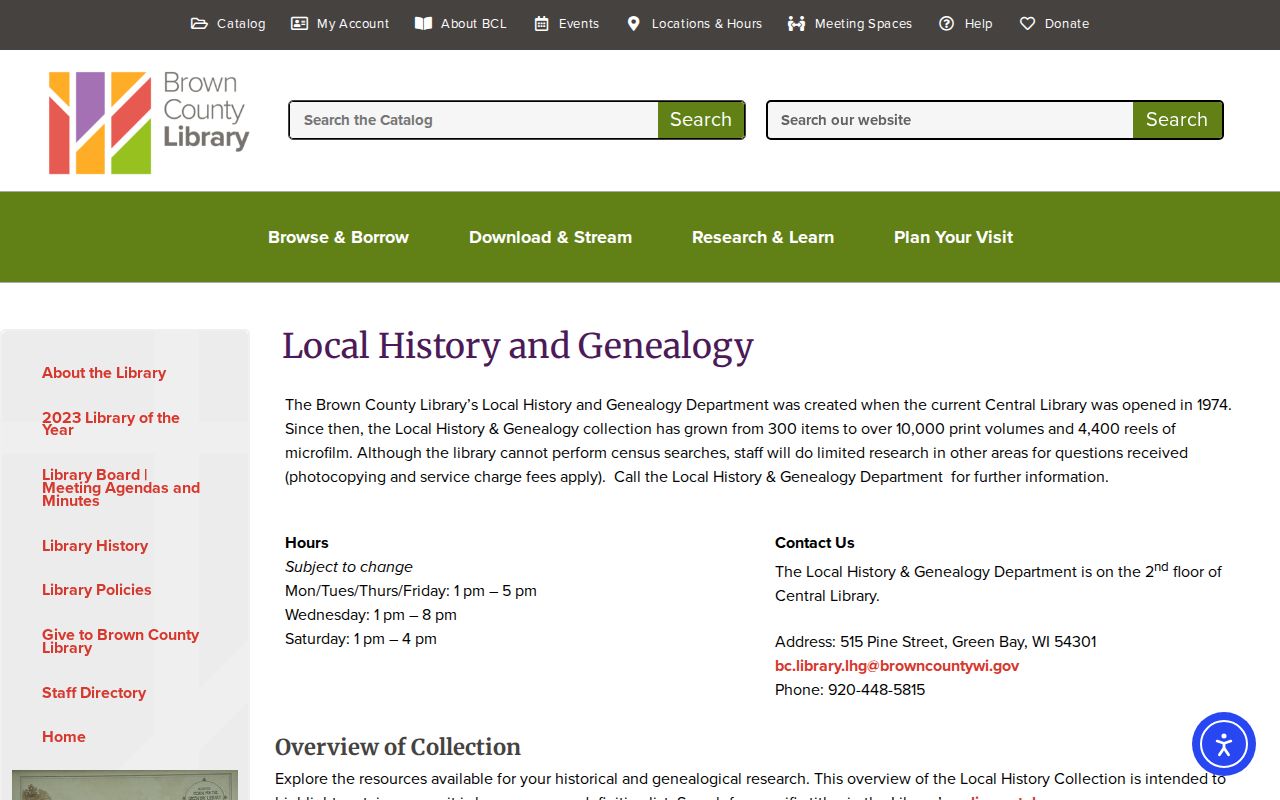
Its inventory helps select a directory, newspaper index, census tool, or microfilm run before asking staff for help.
Brown County GIS Record Changes
BrownDog and the Brown County GIS document library add map context that a text record cannot. Parcel polygons, municipal boundaries, rights-of-way, historic parcel lines, addresses, aerial images, and document links help test whether two records describe the same land. A GIS line is a spatial reference, not a legal survey. Compare it with the parcel ID and recorded legal description before joining names from separate sources.
The county's 2025-2027 Land Information Plan describes automated nightly linking and publishing, with online data synchronization about four times per week. Brown County also posts monthly parcel-change PDFs for 2025 and 2026, including January through July 2026 and a key to change codes. Those dated lists can explain why a current parcel, map shape, legal description, or address differs from an older tax record.
The manifest capture of Brown County GIS resources records the access point during the move toward BrownDog2.0.
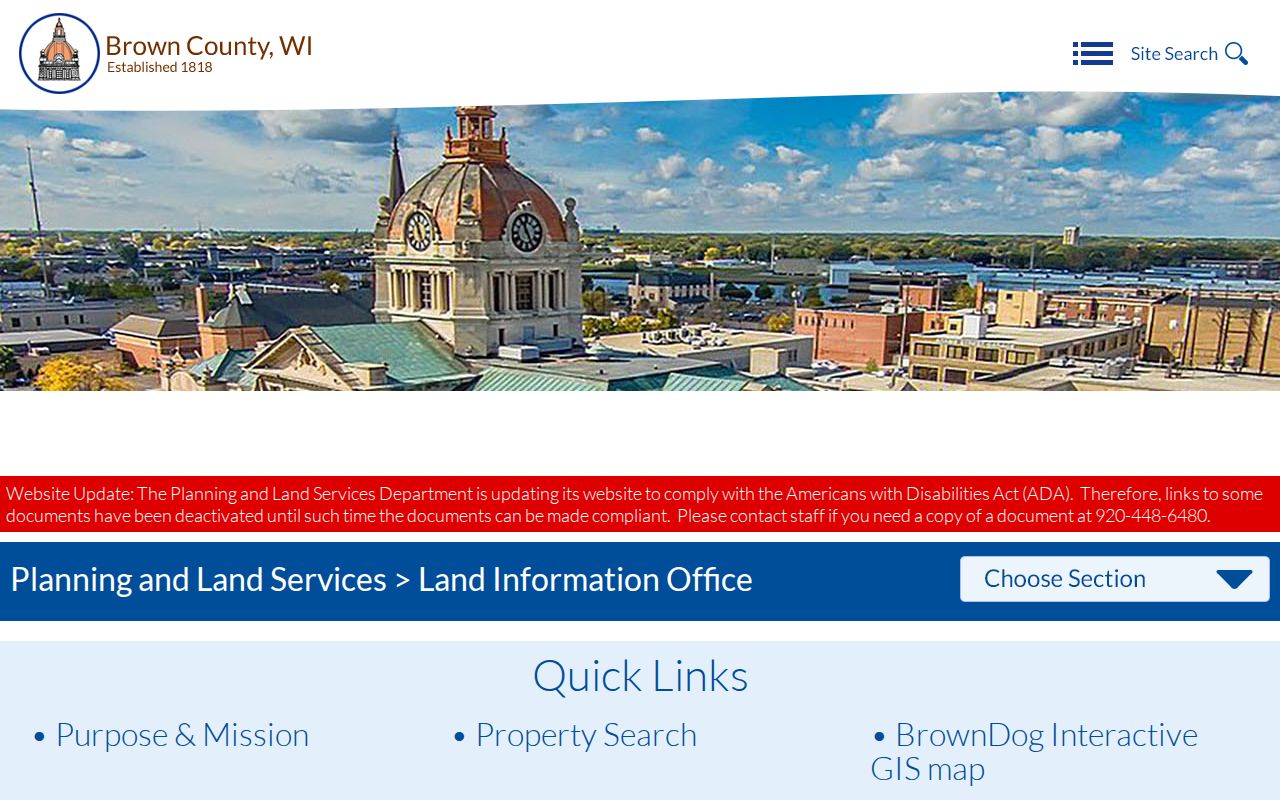
Save the viewer name, layer, parcel ID, screenshot date, and direct record link. That evidence can be reproduced even if an older map application is later retired.
Brown County Record Stopping Rules
A careful search ends when the evidence stops. If a name appears in a deed, label the person as a grantor or grantee. If the same name appears in a voter result, record that match separately with its date and required query details. Court, jail, state custody, registry, business, and credential systems each cover a different legal or official relationship. One does not fill a gap in another.
Keep an evidence log with the exact displayed name, normalized spelling, event or publication date, record type, status, source URL, custodian, and access limit. Store situs and mailing addresses apart. Preserve a parcel's current, alternate, and prior identifiers. For a Brown County residents directory conclusion, state what each source can prove and what it cannot.
A failed portal query should trigger the documented fallback, not a guess. Try spelling variants or Soundex at UWGB, historical parcel controls in Land Records, the Register of Deeds terminal, a municipal clerk or assessor, library microfilm, or a precise public-record request. Stop when the remaining source is restricted, sealed, outside the date range, or cannot be tied to the same person or place.
Historical Brown County Directories
Green Bay city directories survive from the 1870s. Documented editions include 1872-73 and later sample years such as 1893, 1929, 1933, 1942, 1953, 1963, 1974, and 1983. A dated entry may give a householder's name, spouse, job, employer, and street address. Later criss-cross sections reverse the order and list entries by street. The Brown County city directory covers the collection in depth.
Use the Brown County Library for directories, newspapers, census sources, and card indexes. UWGB Archives adds assessment cards, deeds, maps, tax records, photos, and oral histories. Brown County Historical Society offers appointment access at Hazelwood Historic House. Its predecessor began in 1899 with 48 civic leaders and took the countywide name in 1928, which helps explain why local sources now sit with several custodians.
- Roll
- An official or institutional list made for a stated purpose.
- Parcel
- A mapped unit of land with its own identifier.
- Criss-cross directory
- A directory arranged by street and house number.
- Index
- A tool pointing to a record that may be stored elsewhere.