
Brown County Directory Shelves
Brown County city directory research has several real starting points, but no inspected catalog promises one unbroken annual set. The Brown County Library Local History and Genealogy collection holds Green Bay city and Brown County directories, some dating to the 1870s. The Wisconsin Historical Society survey names selected Green Bay editions, while a catalog record identifies R. L. Polk & Co. and Wright's publications. A free scan supplies one early edition. Each source must be cited for the years it actually confirms.
| Directory collection | Confirmed years | Where kept | Access route |
|---|---|---|---|
| Green Bay and Brown County directories | Some from the 1870s | Brown County Library Central | Second-floor local-history collection |
| Green Bay survey references | 1893, 1929, 1933, 1942, 1953, 1963, 1974, 1983 | Wisconsin Historical Society | Use records search, then verify the cited volume |
| Green Bay and Fort Howard directory | 1872-73 | University of Wisconsin digital collection | Free PDF scan |
| Polk and Wright's publications | Cataloged years vary | FamilySearch catalog and holding institutions | Finding aid; confirm image or shelf access |
A missing year is not permission to fill a gap by guesswork. Record the publication title, edition date, page number, geographic coverage, and whether the item was print, microfilm, an index, or a scan. Surrounding places may appear in some publications, but the catalog description must be checked before treating an edition as countywide.
Brown County City Directory Room
The library's collection began in 1974 and now contains more than 10,000 print volumes and 4,400 reels of microfilm. Local History and Genealogy is on the second floor of Central Library, 515 Pine Street in Green Bay. Department hours are Monday, Tuesday, Thursday, and Friday from 1 to 5, Wednesday from 1 to 8, and Saturday from 1 to 4. Those hours differ from the building's general schedule.
Call 920-448-5815 or email bc.library.lhg@browncountywi.gov before a long trip, especially when a certain Brown County city directory edition matters. Staff report limited capacity for research and cannot conduct census searches. A focused question about a title, year, or microfilm reel is more practical than a broad request for a family. Photocopy and service fees may apply.
The library collection page shows the local-history setting used for this research.
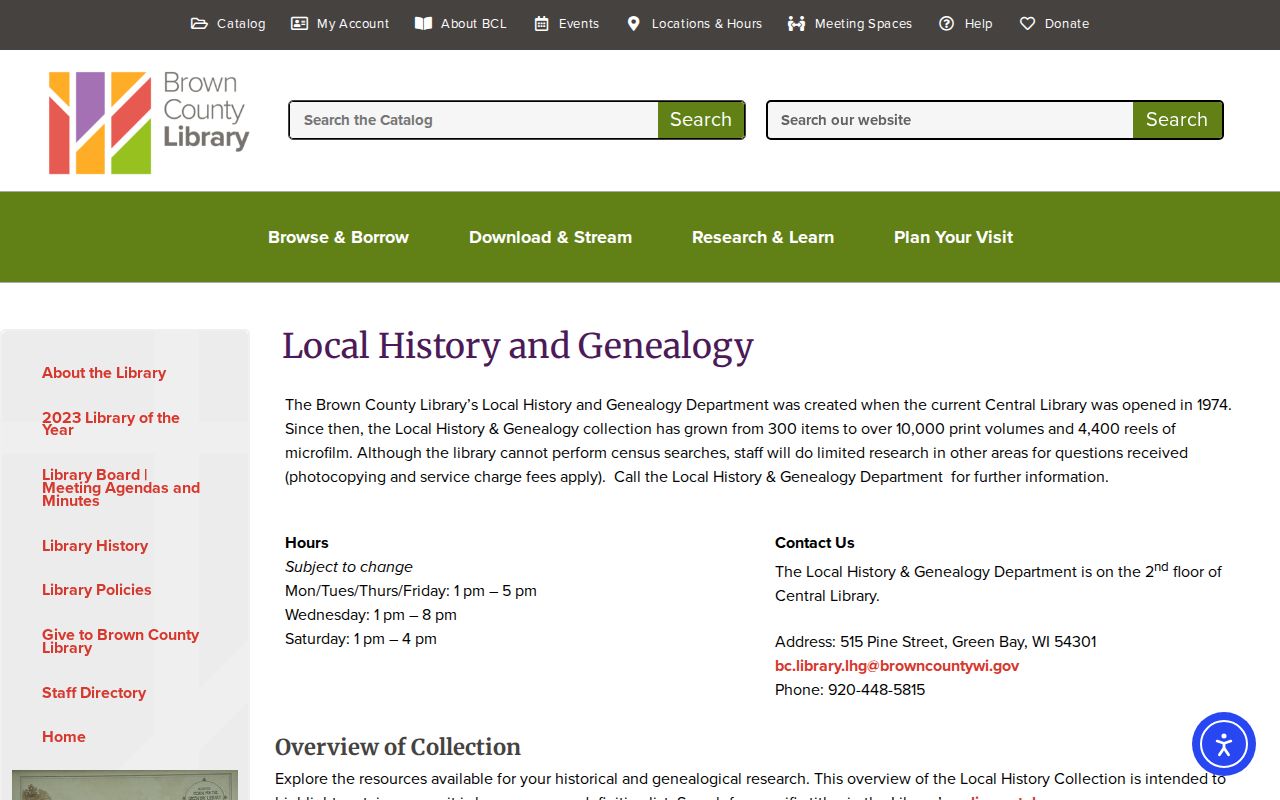
The captured page ties directories to newspapers, census material, card indexes, and microfilm, which makes the room a strong place to resolve a name that appears in only one edition.
Note: Confirm local-history department hours before visiting, since they are narrower than the Central Library's general hours.
Read Brown County Directory Entries
A Brown County city directory entry is a dated clue, not a complete biography. The inspected 1872-73 scan showed government officers and committees, but a specific resident claim still requires an entry-page check. Later directory conventions vary by publisher. Photograph or save the abbreviation key before interpreting short labels, and keep the page that shows the volume title and edition.
| Name | Preserve initials, suffixes, spelling, and the exact printed order. |
|---|---|
| Work label | May identify a trade, business, or employer as printed in that edition. |
| Address | Record the house number, street spelling, and any separate business address. |
| Household context | Some editions add spouse, telephone, or householder details; do not assume all do. |
| Citation | Keep title, edition, page, arrangement, and holding institution. |
Directory shorthand must be read within that volume. A mark that looks familiar may mean something else in another publisher's key.
- Criss-cross directory
- A later directory arranged by street or telephone number rather than only by surname.
- Householder index
- An address-based list used to find the person associated with a dwelling in that edition.
- Abbreviation key
- The publisher's own list explaining compressed terms and symbols used in entries.
- Edition
- The dated publication being searched, which may reflect information gathered before its cover date.
Brown County's 1872 Directory
The Green Bay and Fort Howard directory for 1872-73 is the clearest confirmed digital starting point. It permits page-by-page inspection outside the library. The government page seen during research demonstrates that the book includes civic material as well as names, so a search should not stop at the first likely page.
Use the scan's own pagination and save the full citation. Optical text recognition can miss old type, initials, and unusual spelling. Browse the alphabetical section when a text search fails. Check Fort Howard and Green Bay labels separately, because an early directory's place names and coverage do not map neatly onto modern jurisdiction lines.
Note: The digitized sample confirms the edition and civic pages, not a particular resident entry without direct page inspection.
Brown County Archive Fallbacks
The UW-Green Bay Archives search is a partial index with no digital images. Its fields include first and last name, county, collection name, Soundex, keywords, case type, corporate name, and role type. Results may show name, year, collection, record type, county, and details. A blank result does not prove that no archival record exists.
Try surname-only and spelling variants, then Soundex, which groups similar-sounding surnames. Copies may be requested, or material can be viewed in the archives for free. The request service charges $10 for up to 20 pages, then $0.50 per added page, with $5 added for notarizing. Heavy-traffic estimates run six to eight weeks. Contact the archives at 920-465-2539 or archives@uwgb.edu.
The archive request screen shows the search and order route.
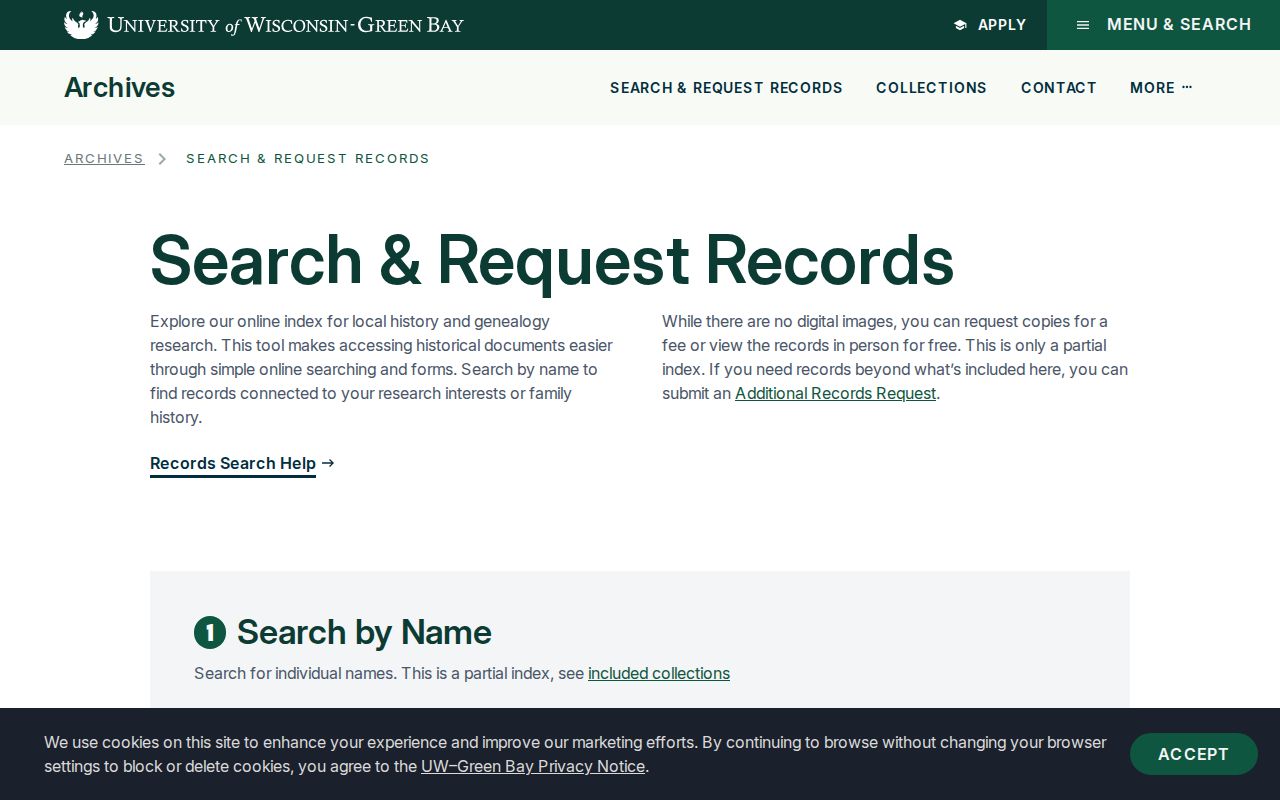
The visible form reinforces a key practice: preserve each name variant and collection label before requesting a copy.
Brown County Directory Year Gaps
Newspapers help bridge years when a city directory is absent. Brown County Library lists Green Bay Gazette variants from 1870 through June 28, 1915 and the Advocate from 1877 through 1885. The Press-Gazette is digitized from January 29, 1915 to about one week before the library page update. Later finding aids include a card-file index for 1962-1983, a print subject index from July 1985 through December 1996, an online catalog index for 1997-2003, and full text from 1999 onward through U.S. Newsstream.
Search the date range beside the directory year, then label the finding as a newspaper notice rather than a directory entry. Overlapping coverage does not guarantee that every issue is searchable on every platform. An obituary, business notice, property transfer, or civic item can explain a move or a name change, but the source and date must remain distinct.
Brown County Addresses Change
The Wisconsin Historical Society record for 110 South Adams Street preserves a useful continuity clue: the property was formerly numbered 112 South Adams after rehabilitation. That documented change shows why a modern address may fail in an old city directory.
Compare the directory address with dated maps and the property's legal trail. The Library of Congress has a 31-sheet Green Bay and Fort Howard Sanborn set from 1900 and an 85-sheet Green Bay set from 1907. These fire-insurance maps can show a building footprint, use, materials, and stories, but not a full household roster. Pair the sheet with a directory and census record.
The UW-Green Bay house-history source map illustrates how directories join assessment cards, deeds, maps, tax rolls, and newspapers.
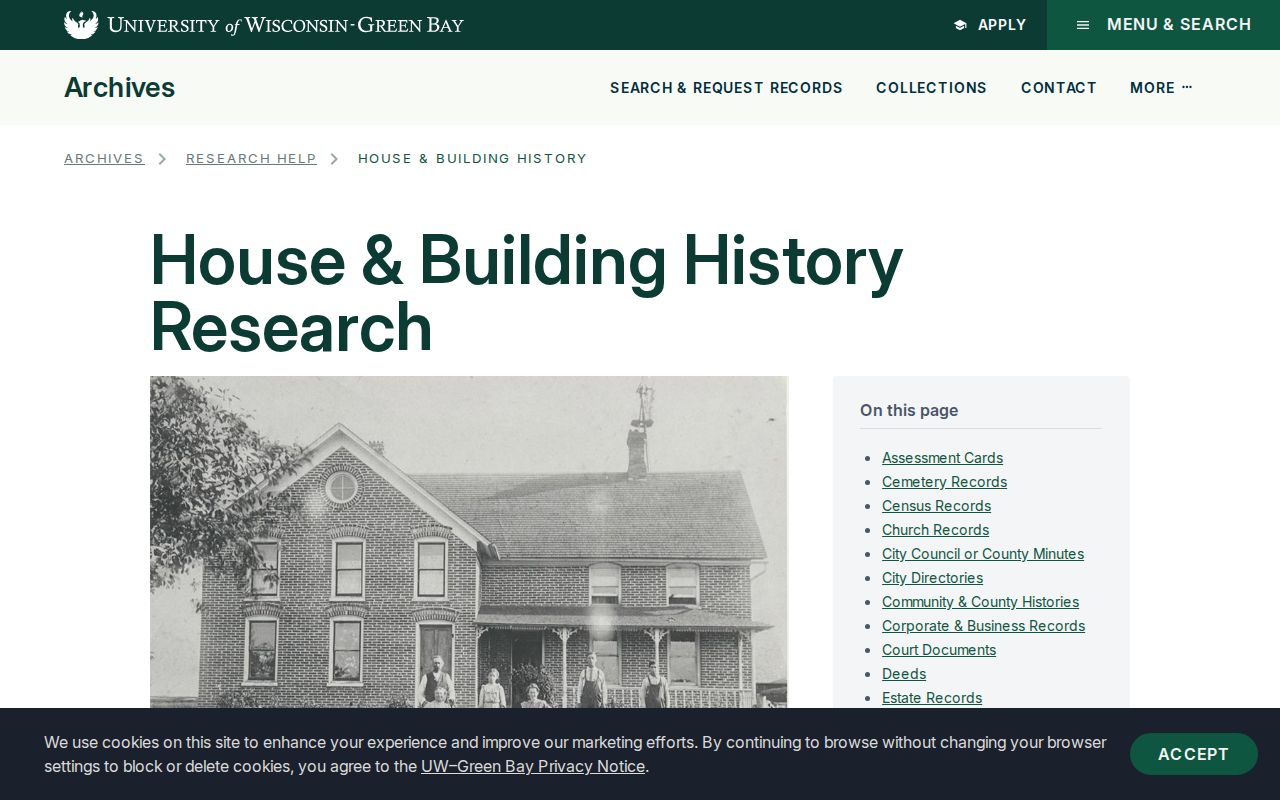
The source mix is especially useful when street numbers, parcel lines, or municipal labels change between editions.
Brown County Historical Society Story
The Green Bay Historical Society began in 1899 with 48 civic leaders and became the Brown County Historical Society in 1928. That history adds context to the county's preservation network, but the inspected official material did not identify exact city directory runs held by the society. Ask about a specific title or year instead of presuming a complete shelf.
The society operates from Hazelwood Historic House, 1008 South Monroe Avenue in Green Bay. Office hours are Monday through Friday, 8:30 to 4, and the contact number is 920-437-1840. House and group visits are by appointment. The society can be a referral point when library and archive catalogs leave a local-history question unresolved.
Trace Brown County Directory Families
Family-history work is strongest when each city directory match is tested against another dated source. Start with a known name and approximate year. Keep similar names separate until address, spouse, or another detail supports a match.
- Find the earliest confirmed edition and save the exact entry, title page, edition, and page.
- Move to the next confirmed directory year. Note street changes, initials, work labels, and household context.
- Check an address-arranged or criss-cross section when available, but do not infer relationships among nearby listings.
- Pair directory dates with federal, state, or territorial census holdings at Brown County Library.
- Use newspaper indexes, archival property files, or vital genealogy records to explain a disappearance or name change.
The library has federal census material for Wisconsin counties from 1820 through 1930, with the 1890 population schedules lost to fire, plus Brown County and selected-area coverage for 1940. State census years include 1855, 1875, 1885, 1895, and 1905. Territorial schedules add earlier checkpoints. HeritageQuest through BadgerLink can provide census, book, cemetery, directory, and military material with library-card access.
A person who vanishes from a Brown County city directory may have moved, died, changed names, or simply gone unlisted. Treat each as a possibility until a second source narrows the answer. For modern address work, use the Brown County street directory rather than extending an old edition beyond its date.